
Project Information
How We Scaled a Jewelry Brand to 33,646 Shopify Orders Using Meta & TikTok Ads
Scaling an e-commerce brand is not simply about increasing ad spend. The real challenge is increasing purchase volume while keeping customer acquisition costs under control and ensuring that paid traffic actually converts into revenue.
In this performance marketing case study, we break down how we helped a jewelry e-commerce brand scale across Meta Ads and TikTok Ads, while improving the overall performance of its Shopify store.
During the selected reporting period, the store generated:
- Rs 68.91M in Shopify sales
- 33,646 Shopify orders
- +95% growth in orders
- 4.52% conversion rate
- +140% improvement in conversion rate
- 4.61x Meta Ads ROAS
- 5.56x TikTok Ads ROAS
What makes these results particularly interesting is that Shopify sessions were actually 5% lower than the comparison period.
In other words, the growth was not simply created by sending more traffic to the website. The store became significantly more efficient at turning traffic into customers.
The Challenge: Scaling Without Losing Efficiency
For many e-commerce brands, performance starts to decline as advertising budgets increase.
A campaign that generates excellent results at a small daily budget may become much less profitable when spend is scaled. Cost per purchase can rise, audiences can become saturated, and creative performance can decline.
The objective for this jewelry brand was therefore not just to increase traffic.
The goal was to build a more scalable e-commerce performance marketing system across Meta and TikTok that could generate purchase volume while maintaining healthy acquisition economics.
We focused on the metrics that directly affected business performance:
Purchase volume, cost per purchase, ROAS, Shopify orders, store conversion rate and total sales.
Instead of optimizing around vanity metrics such as likes, engagement or cheap clicks, decisions were made based on actual purchase behavior.
Meta Ads Performance: Rs 4.62M Spend and 13,153 Purchases
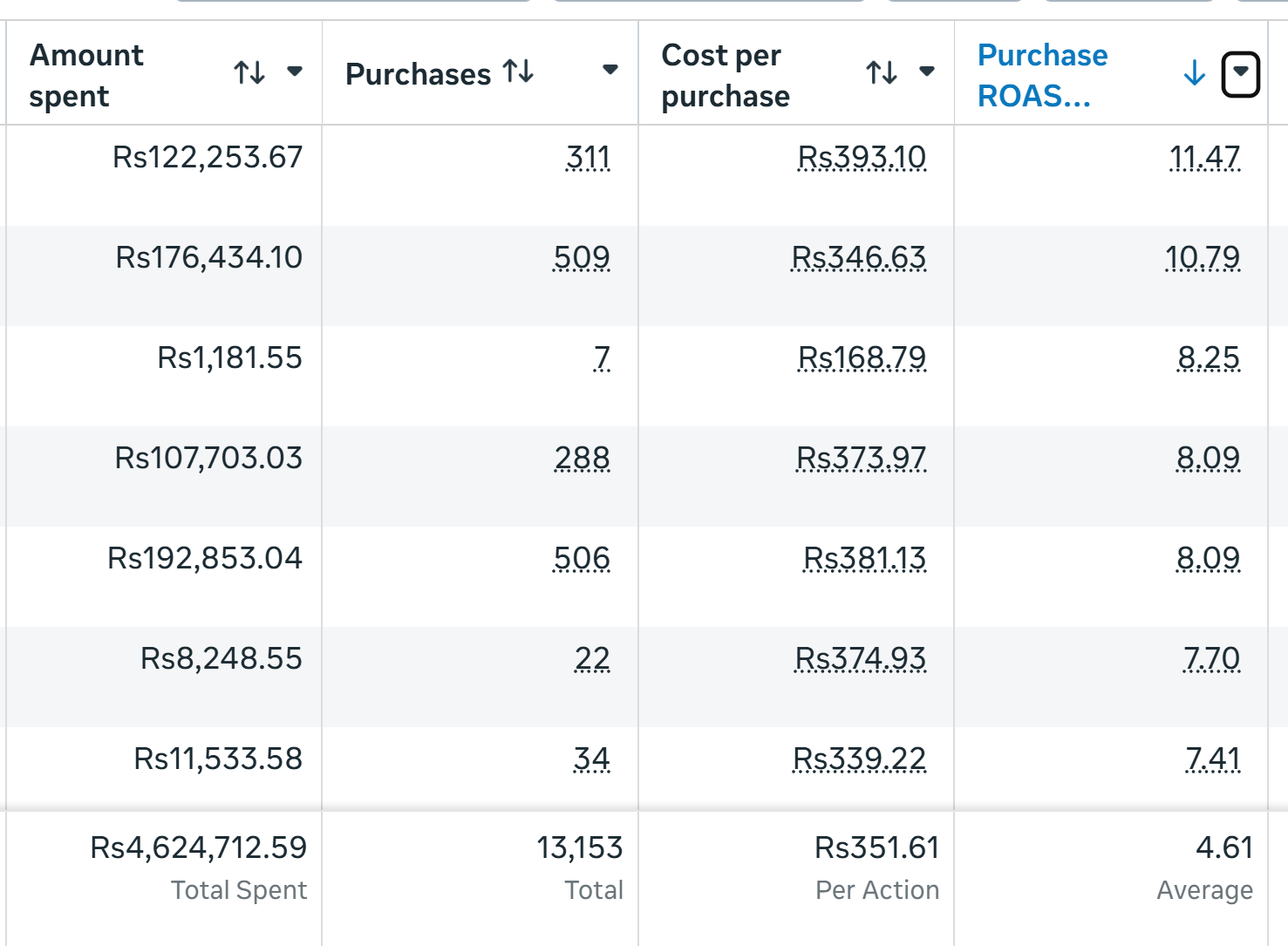
Meta Ads played an important role in the brand’s paid acquisition strategy.
During the reporting period, the Meta Ads account recorded:
Total ad spend: Rs 4,624,712.59
Attributed purchases: 13,153
Average cost per purchase: Rs 351.61
Purchase ROAS: 4.61x
A 4.61x ROAS means that Meta attributed approximately Rs 4.61 in purchase value for every Rs 1 invested in advertising.
But looking only at the account average does not tell the full story.
The account contained several campaigns or segments performing significantly above the overall average.
Some of the stronger results visible inside Ads Manager included:
- 11.47x Purchase ROAS
- 10.79x Purchase ROAS
- 8.25x Purchase ROAS
- Multiple segments around 8x ROAS
One particularly strong segment generated 509 purchases at Rs 346.63 per purchase while maintaining a 10.79x ROAS.
That distinction matters.
A very high ROAS on a tiny budget may look impressive, but it does not necessarily prove that a campaign can scale.
Generating hundreds of purchases while maintaining efficient acquisition costs provides much stronger evidence of a scalable campaign.
What We Focused on Inside Meta
Our approach was centered around identifying the combinations of campaign structure, creative, product and audience that consistently generated purchases.
Budget was then prioritized toward areas capable of maintaining performance at higher spend.
Rather than treating every campaign equally, performance was evaluated based on both efficiency and volume.
This is a key principle in successful Facebook Ads and Meta Ads management for e-commerce brands.
TikTok Ads Performance: 20,529 Purchases at $1.27 Each
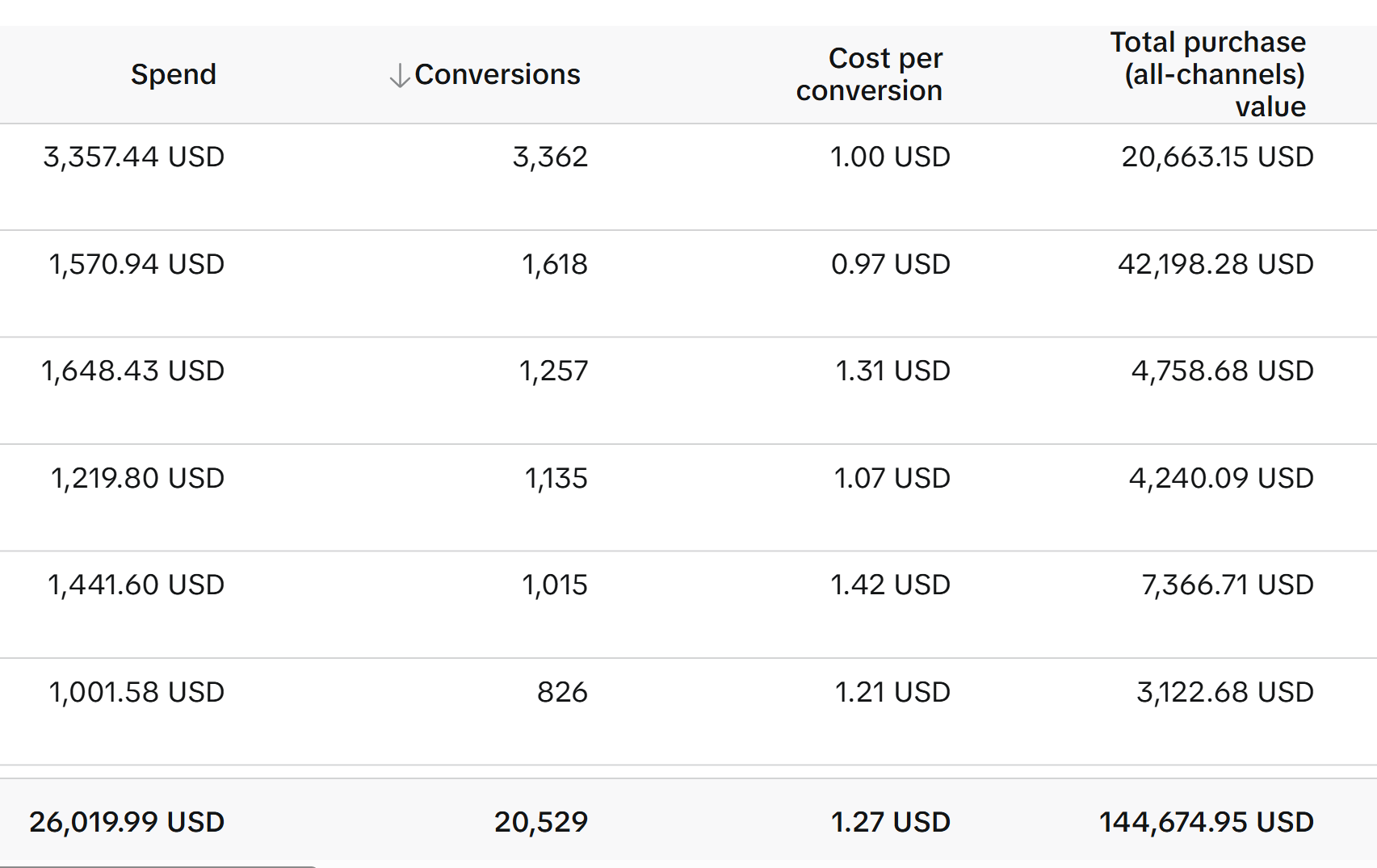
TikTok provided another major acquisition channel for the brand.
According to TikTok Ads Manager, the account generated:
Ad spend: $26,019.99
Attributed purchases: 20,529
Average cost per purchase: $1.27
Attributed purchase value: $144,674.95
Based on the reported purchase value and spend, TikTok delivered approximately:
5.56x ROAS
That means TikTok attributed around $5.56 in purchase value for every $1 spent on advertising.
Some individual campaigns performed considerably above the account average.
For example, one segment spent approximately $1,570.94, generated 1,618 purchases at $0.97 per purchase, and recorded $42,198.28 in purchase value.
Performance naturally varied across campaigns, which is expected in any scaled advertising account.
The objective is not to make every campaign perform identically.
The job of performance marketing is to continuously identify where capital is producing the strongest return and allocate budget accordingly.
Why TikTok Was Valuable
TikTok can be particularly effective for visually driven consumer products such as jewelry.
The platform’s discovery-based environment allows strong creatives and products to reach new audiences quickly.
Combined with Meta, it also reduces reliance on a single paid acquisition platform.
Instead of depending completely on one advertising ecosystem, the brand had multiple channels capable of generating purchase demand.
Shopify Results: The Most Important Part of the Case Study
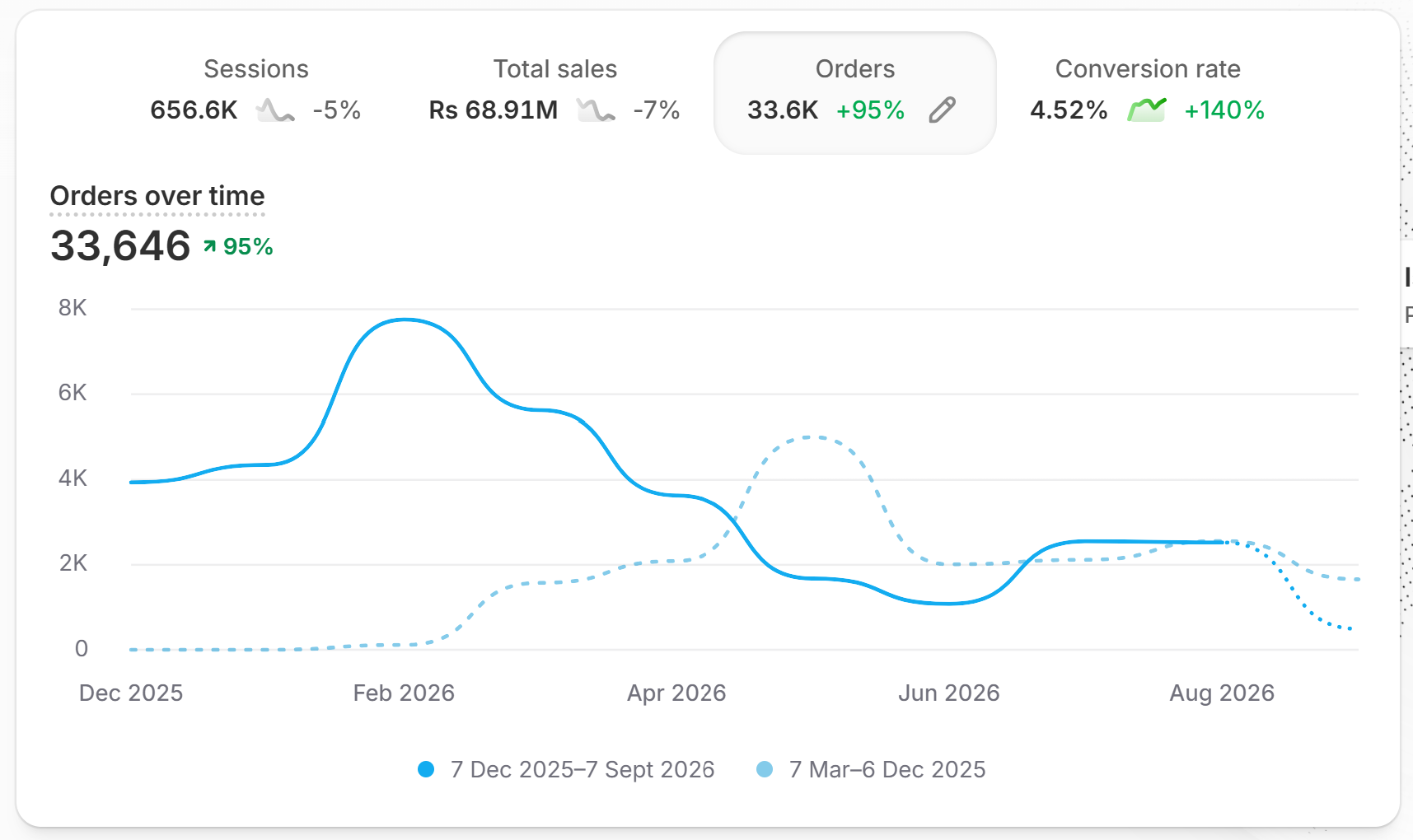
Ad-platform results are important, but the most important numbers ultimately come from the store itself.
Shopify provides the clearest picture of what happened at the business level.
During the selected period, Shopify recorded:
656.6K sessions
Rs 68.91M in total sales
33,646 orders
4.52% conversion rate
The most important comparison was the change in orders and conversion efficiency.
Shopify orders increased by:
+95%
And the store’s conversion rate increased by:
+140%
At the same time, sessions were:
5% lower
This is one of the strongest insights from the entire case study.
The store almost doubled its order volume despite receiving slightly less traffic.
That suggests the growth was driven by significantly stronger conversion efficiency rather than simply buying more website visitors.
For any Shopify performance marketing strategy, this distinction is critical.
More traffic does not automatically mean more profitable growth.
Improving the percentage of visitors who actually purchase can have a much larger impact on the business.
Why We Keep Shopify, Meta and TikTok Attribution Separate
There is an important detail when evaluating these numbers.
Meta reported 13,153 attributed purchases, while TikTok reported 20,529 attributed purchases.
Shopify recorded 33,646 actual orders during the selected period.
It can be tempting to simply add the Meta and TikTok numbers together and present them as unique customers.
We intentionally do not do that.
Advertising platforms use their own attribution models.
For example, a customer could discover the brand through TikTok, later interact with a Meta ad and eventually complete the order.
Depending on attribution windows and tracking, more than one platform may claim credit for that purchase.
For this reason, we use:
Meta and TikTok for channel-level acquisition performance
and
Shopify as the source of truth for store-level orders and revenue.
This creates a much more accurate view of overall performance and avoids inflated attribution claims.
The Business Impact
The final outcome was not simply stronger advertising metrics.
During the selected reporting period, the jewelry brand generated 33,646 Shopify orders and Rs 68.91M in total sales.
More importantly, Shopify order volume increased 95%, while the store’s conversion rate improved 140% to 4.52%.
Meta maintained a 4.61x ROAS, while TikTok delivered approximately 5.56x ROAS.
The result was a stronger multi-channel acquisition system combined with significantly improved store-level conversion efficiency.
Results at a Glance
Rs 68.91M Shopify Sales
33,646 Shopify Orders
+95% Order Growth
4.52% Shopify Conversion Rate
+140% Conversion Rate Growth
4.61x Meta Ads ROAS
5.56x TikTok Ads ROAS